
The FATF announced its updated lists on 30 October 2026: DRC, Monaco, Bulgaria, and Côte d’Ivoire left the grey list, no jurisdictions joined it, and the blacklist was unchanged. Many UAE compliance officers ask the same question after every update: does this change what I file on goAML? The short answer is that grey list changes affect risk assessment, while blacklist (call-for-action) changes affect mandatory goAML reports.
October 2026 FATF changes at a glance
Grey list additions: None
Grey list removals: DRC, Monaco, Bulgaria, and Côte d’Ivoire
Grey list total: 18
Blacklist (call for action): No change
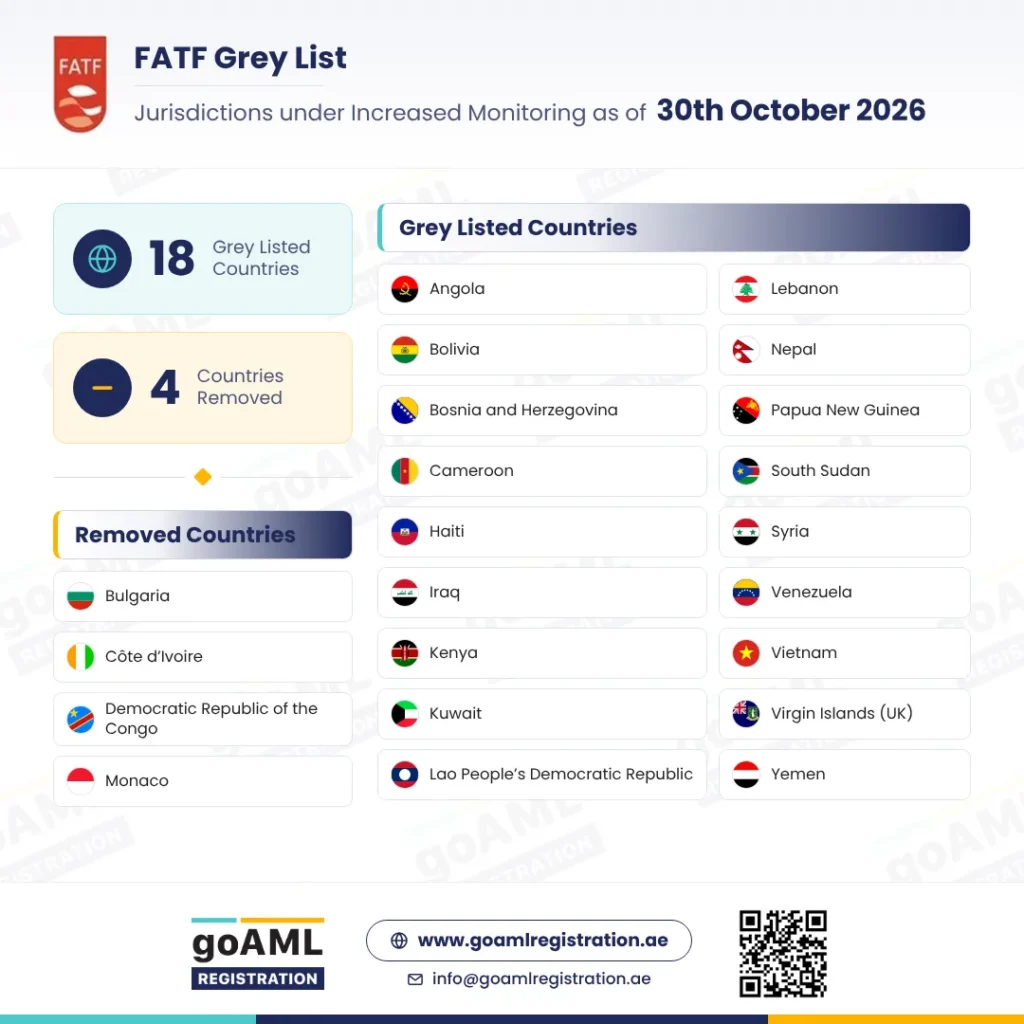
Updated FATF grey list, 30 October 2026
- Angola
- Bolivia
- Bosnia and Herzegovina
- Cameroon
- Haiti
- Iraq
- Kenya
- Kuwait
- Lao People’s Democratic Republic
- Lebanon
- Nepal
- Papua New Guinea
- South Sudan
- Syria
- Venezuela
- Vietnam
- Virgin Islands (UK)
- Yemen
Updated FATF blacklist, 30 October 2026
- Iran and DPRK: the FATF calls on members to apply countermeasures.
- Myanmar: the FATF calls for enhanced due diligence proportionate to the risk, without disrupting humanitarian aid or remittance flows.
Which goAML reports are affected?
Report | When it applies | Affected by this update? |
HRC: High-Risk Country Transaction Report | Cross-border transactions to, from or through call-for-action jurisdictions | No |
HRCA: High-Risk Country Activity Report | DNFBP activity linked to call-for-action jurisdictions, or where HRC transaction details are unavailable | No |
STR / SAR | Where there are reasonable grounds to suspect a crime, regardless of country | Indirectly: grey list links may surface new red flags |
Grey-listed countries: no automatic goAML report
Dealing with a customer or counterparty in a grey-listed jurisdiction does not by itself require a goAML filing. It should, however, raise the geographic risk score and may trigger enhanced due diligence. If that review uncovers suspicious indicators, file an STR or SAR without delay.
Steps for UAE reporting entities after the update
- Confirm your goAML registration is active and that your MLRO and deputy have working access.
- Update your high-risk country list for screening and HRC/HRCA triggers.
- Brief front-line staff on which transactions now need escalation.
- Re-rate affected customers and document the EDD performed.
- Keep records of the change, the date it took effect and any reports filed.
Not registered on goAML yet?
Every UAE financial institution, DNFBP and VASP must be registered with the UAE FIU on goAML to file reports. If you are not registered, you cannot meet HRC, HRCA or STR obligations triggered by FATF list changes.
FAQs on the FATF grey list update, October 2026
Not by itself. HRC and HRCA reports apply to call-for-action (blacklist) jurisdictions. Grey list links require a risk-based review, and an STR if suspicion arises.
HRC covers cross-border transactions linked to call-for-action jurisdictions. HRCA covers DNFBP activity linked to them, or cases where HRC transaction details are unavailable.
Jurisdictions subject to the FATF call for action. As of 30 October 2026, these are Iran, North Korea (DPRK) and Myanmar.
None. No countries were added to the FATF grey list at the Plenary that concluded on 30 October 2026. DRC, Monaco, Bulgaria, and Côte d’Ivoire were removed.
Yes. All UAE reporting entities must be registered on goAML with the UAE FIU.
Put an AML Policy in Place That Meets UAE Standards
Custom AML policies and procedures aligned with UAE AML law and supervisory expectations for Real Estate Agent.
Independent AML Review for Real Estate Agents
Obtain an objective assessment of your AML, CFT, and CPF compliance against federal law and supervisory guidance.
Build a Risk-Based AML Program
Implement practical CDD, EDD, and monitoring systems tailored to high-value property transactions and cross-border exposure.
Yes. Real estate agents are formally classified as Designated Non-Financial Businesses and Professions (DNFBPs) under UAE federal AML legislation. This means they are legally required to comply with anti-money laundering (AML), counter-terrorist financing (CFT), and counter-proliferation financing (CPF) obligations comparable in structure to regulated financial institutions, calibrated to sector-specific risk exposure.
A business falls within scope where it conducts real estate activities on behalf of clients. This includes:
Real estate brokerage firms
Property consultants and transaction intermediaries
Leasing and rental agents
Off-plan sales representatives
Firms facilitating high-value or complex property transfers
Classification is determined by the nature of the activity performed, not merely the company title.
Real estate agents operating in mainland UAE and relevant commercial free zones are supervised by the Ministry of Economy and Tourism.
The Ministry conducts inspections, reviews reporting through goAML, issues sector-specific circulars, and applies administrative penalties where non-compliance is identified.
The principal legislation is Federal Decree Law No. 10 of 2025, which establishes enforceable AML, CFT, and CPF obligations for reporting entities, including DNFBPs.
It is supported by Cabinet Resolution No. 134 of 2025 (Executive Regulations), which operationalises compliance requirements such as:
Risk-based approach implementation
Enhanced Due Diligence (EDD) triggers
Transaction monitoring expectations
Supervisory inspection powers
Real estate agents must implement a structured compliance framework including:
A documented Business Risk Assessment (BRA) aligned with national risk findings
Customer Due Diligence (CDD) and beneficial ownership verification
Enhanced Due Diligence for higher-risk customers (e.g., PEPs, high-risk jurisdictions)
Ongoing transaction monitoring
Suspicious Transaction Reporting (STR) through goAML
Targeted Financial Sanctions (TFS) screening
Record retention mechanisms
Appointment of an empowered AML Compliance Officer
Supervisory reviews assess operational effectiveness, not just policy documentation.
Yes. Under Ministry Circular No. 05/2022, firms must submit a Real Estate Activity Report through goAML when qualifying freehold property transactions are settled in cash or virtual assets above prescribed thresholds.
The UAE’s Money Laundering and Terrorist Financing National Risk Assessment (ML/FT NRA) and Proliferation Financing National Risk Assessment (PF NRA) establish the national risk baseline.
Real estate agents must embed these findings into their Business Risk Assessment, sanctions screening controls, and escalation procedures.
Regulators evaluate whether firms demonstrate alignment with national risk exposure — particularly in areas such as:
High-value property transactions
Offshore and layered ownership structures
Foreign investor involvement
Sanctions and proliferation financing exposure
Administrative penalties are governed by Cabinet Resolution No. 71 of 2024, which applies to entities supervised by the Ministry of Economy and the Ministry of Justice.
Sanctions may include financial penalties, regulatory measures, and enhanced supervisory scrutiny depending on the severity and nature of the breach.